Sayan Biswas: How Deep Tech Evolves from Research to Real-World Impact
by ago0
Sayan Biswas, PhD, is an engineer, educator, and business strategist whose work has focused on science and technology policy, advanced engineering research, and sustainable innovation. Through his experience in both academia and government, Sayan Biswas has worked on initiatives that connect scientific discovery with practical applications in industry and society. As a science and technology policy fellow with the United States Department of Energy, he contributed to efforts aimed at moving federally funded technologies from laboratory research toward commercialization. His background also includes leading a federally and state-funded academic research laboratory supported by organizations such as NASA, the Department of Energy, and the Department of Defense. With expertise spanning aerospace engineering, mechanical engineering, and technology commercialization, Dr. Biswas brings practical insight into the process through which deep tech innovations evolve from research concepts into real-world solutions.
How Deep Tech Evolves from Research to Real-World Impact
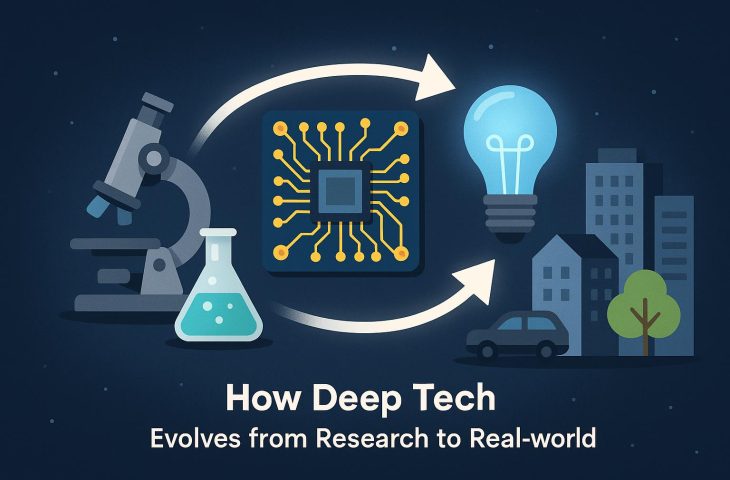
“Deep tech” refers to technologies rooted in advanced scientific and engineering breakthroughs, often emerging from universities, national laboratories, or corporate research centers. These innovations include fields like advanced energy systems, quantum technologies, biotechnology, and next-generation materials. While the scientific foundations are often strong, the path from research to real-world impact is rarely direct. It is a long, iterative process shaped by technical validation, policy environments, funding structures, and market readiness.
Most deep tech begins in research settings where the primary goal is discovery rather than commercialization. In these environments, success is measured by publications, experimental results, and proof of concept demonstrations. However, translating early-stage findings into usable technologies requires a shift in mindset. The question becomes not only whether something works in controlled conditions, but whether it can operate reliably, safely, and cost-effectively in the real world.
The next stage is often proof of concept and prototype development. This is where theoretical ideas are tested in more practical environments. Many technologies fail or are significantly redesigned at this stage because real-world conditions introduce variables that are not present in laboratory settings. Materials degrade, systems behave unpredictably, and scaling introduces new constraints. According to the U.S. Department of Energy, this “valley of death” between research and commercialization is one of the most challenging phases for clean energy and advanced technology development.
Funding plays a critical role during this transition. Early research is often supported by grants, but scaling requires investment from venture capital, government programs, or industry partnerships. Each funding source brings different expectations. Public funding may prioritize societal benefit and long-term impact, while private investment focuses on scalability and return on investment. Aligning these expectations is essential for sustained progress.
Policy and regulation also shape the trajectory of deep tech. Technologies that interact with infrastructure, energy systems, or public safety must meet regulatory standards before widespread deployment. This can slow adoption, but it also ensures safety and reliability. In many cases, policy frameworks lag behind technological innovation, creating uncertainty for developers. At the same time, supportive policies such as demonstration funding, tax incentives, or pilot programs can accelerate adoption by reducing risk.
As technologies mature, pilot projects and demonstration-scale deployments become essential. These projects test performance outside the lab and generate data on cost, reliability, and user behavior. They also help build confidence among stakeholders, including investors, regulators, and end users. The International Energy Agency has noted that demonstration projects are a crucial step in scaling clean energy technologies, as they bridge the gap between innovation and market readiness.
Market adoption represents the final and most complex stage. Even technically successful innovations can fail if they do not align with market needs, cost expectations, or existing infrastructure. Adoption often depends on incremental improvements rather than sudden breakthroughs. Technologies must integrate into existing systems or create new ecosystems that support their use.
Throughout this lifecycle, feedback loops are constant. Lessons from deployment influence new research directions, while policy and market signals shape what types of innovation receive funding and attention. This dynamic interaction means that deep tech evolution is not linear but cyclical, with continuous refinement across stages.
The journey from research to real-world impact requires coordination across disciplines, sectors, and institutions. When these elements align, deep tech can move beyond theoretical promise and become a practical force that reshapes industries, infrastructure, and everyday life.
About Sayan Biswas
Sayan Biswas, PhD, is an engineer, researcher, and business leader with experience in science and technology policy, aerospace engineering, and sustainable innovation. He previously served as a science and technology policy fellow with the U.S. Department of Energy and has led federally and state-funded research initiatives supported by NASA, the Department of Defense, and the Department of Energy. Dr. Biswas earned his doctorate in aerospace engineering from Purdue University and remains active in several engineering and scientific professional organizations.
Related posts

Technology / by - ago
Understanding the Importance of Recovery After Workouts
After a game of ball, running or a gym session you will feel tired and most likely sore. Recovery is a process your body goes through to repair the tissues…

Technology / by - ago
The Digital Ashram of Guarahari Das: The Doctrine of William Zodda
Religion has always found ways to adapt to new forms of communication. Sacred teachings once traveled through oral traditions. Later they were preserved in manuscripts, printed books, radio broadcasts, television…

Technology / by - ago
Mechanical Light Timers and Smart Plugs: Low vs. High-Tech Control
My father was never one to shy away from technology. I remember in the 1970s he bought half a dozen mechanical light timers to automate home lighting. My mother considered…

Technology / by - ago
Lara Karakasevic: How Sound Baths Support Whole-Body Wellness
Lara Karakasevic is a culinary wellness practitioner and living food chef based in Kamuela, Hawaii, who has spent years helping clients address stress and support their bodies’ natural healing abilities. Since…