Why Modern Vessels Need Both 5G and Satellite Connectivity
by ago0
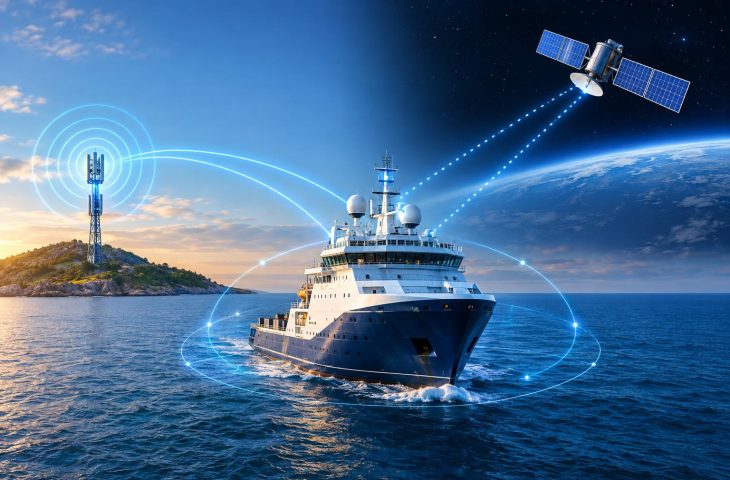
A vessel can leave a port with strong mobile coverage and move beyond the practical range of coastal networks only a few hours later. Yet the demand for connectivity does not stop at the shoreline. Navigation data, weather information, operational systems, telemetry, remote support, crew communications and passenger services can all depend on a stable connection throughout the voyage.
That makes maritime connectivity fundamentally different from internet access at a fixed location. The available network changes as the vessel moves. Instead of choosing between cellular and satellite as competing technologies, many operators now have to think about how the two can work together.
Coverage changes with the voyage
Near ports and populated coastlines, commercial mobile networks can provide fast and cost-effective connectivity. 4G is widely available in many coastal areas, while 5G can add higher capacity and lower latency where coverage is mature. For vessels that spend significant time near shore, cellular connectivity can therefore carry a large share of normal traffic.
But coastal coverage has limits. Signal quality can vary with distance from shore, geography, network congestion and antenna placement. Once a vessel moves sufficiently far offshore, terrestrial mobile service is no longer a dependable primary connection. At that point, satellite becomes essential.
Where 5G has the advantage
5G is attractive for maritime operators because it can deliver the type of performance users expect on land when a vessel is within range of a suitable network. High throughput supports cloud applications, software updates, video calls and large file transfers. Lower latency can improve interactive applications and remote access to onboard systems.
For vessels that regularly operate around ports, inland waterways and coastal routes, maritime 5G internet can therefore reduce reliance on more expensive satellite capacity while still supporting demanding onboard applications.
The benefit is not only speed. Cellular plans can offer a more economical path for high-volume traffic in areas where coverage is strong. That makes it sensible to use terrestrial networks whenever possible rather than treating satellite as the default connection for every location and every application.
Why satellite remains essential offshore
Satellite solves the coverage problem that cellular networks cannot. Modern low Earth orbit services can provide broadband connectivity across large maritime areas without depending on nearby coastal infrastructure. This is especially important for commercial vessels, offshore energy operations, research ships and yachts that spend long periods outside terrestrial coverage.
Satellite also creates a different type of resilience. A terrestrial outage near a port may affect local mobile infrastructure, while an independent satellite path can keep a vessel connected. Conversely, satellite performance can be affected by hardware issues, obstruction or service conditions, so retaining cellular as an alternative when the vessel returns to coverage adds another layer of flexibility.
The practical case for hybrid connectivity
The strongest maritime network is often not the one with the single fastest connection. It is the one that can use the most appropriate connection as conditions change. A hybrid design allows the vessel to treat cellular and satellite as complementary parts of the same network rather than separate systems that crews must manage manually.
Use the best link for the situation
When strong 4G or 5G coverage is available, routine and high-volume traffic can use the cellular connection. As coverage weakens, the network can shift important traffic to satellite. This approach can help balance performance, availability and cost across a voyage.
The exact policy depends on the vessel. A passenger service may prioritise guest Wi-Fi differently from a cargo operator focused on operational telemetry. An offshore support vessel may need stable access to remote experts and cloud systems, while a yacht may place more emphasis on video, entertainment and business applications.
Keep critical traffic available
Hybrid networking also supports failover. If one connection drops, a router can move traffic to another available path. For critical systems, that is more valuable than simply having a second connection that requires manual intervention.
Traffic policies can also distinguish between applications. Operational communications and safety-related data may receive priority, while entertainment traffic is limited or delayed when bandwidth is constrained. This becomes increasingly important when several onboard systems share the same external links.
Connectivity is now part of vessel operations
The maritime industry is becoming more dependent on digital systems. Engine and equipment telemetry can support condition monitoring. Remote diagnostics can allow shore-based specialists to investigate faults. Weather and routing platforms depend on current data. Electronic charts and software require updates. Crew welfare increasingly depends on reliable access to communication and entertainment services.
As these applications grow, network management becomes more important. Operators need visibility into data usage, link performance and failures across the fleet. A vessel may be able to connect through several carriers and satellite services, but without central oversight that flexibility can quickly become operational complexity.
The future is not cellular or satellite
The question for modern vessels is no longer whether 5G can replace satellite or whether satellite makes cellular unnecessary. Their strengths are different. 5G offers strong performance and attractive economics near shore. Satellite extends the network across offshore routes where terrestrial coverage ends.
Used together, they allow connectivity to follow the vessel rather than forcing the vessel to depend on one network type. That hybrid approach is increasingly well suited to a maritime environment where coverage, bandwidth requirements and operational priorities can change from one stage of a voyage to the next.
Related posts

Technology / by - ago
Technology For Upgrading Your Pet’s Quality of Life
Technology has made many advancements and innovations in many aspects, including pet items. There are gadgets that can provide entertainment, a way of communication, support their health and help them…

Technology / by - ago
Vikrum Aiyer: How Cycling Offers Personal and Environmental Benefits
Vikrum Aiyer is a policy strategist and communications executive based in San Francisco whose work spans government, technology, and climate innovation. Since 2022, he has served as head of global public…

Technology / by - ago
Keeping Your Focus: Techniques and Principles to Adopt
Focus is a skill that people have to learn to avoid getting sidetracked by other things. It is a mental skill that keeps you glued to one thing and one…

Technology / by - ago
Understanding the Importance of Recovery After Workouts
After a game of ball, running or a gym session you will feel tired and most likely sore. Recovery is a process your body goes through to repair the tissues…