Mechanical Light Timers and Smart Plugs: Low vs. High-Tech Control
by ago0
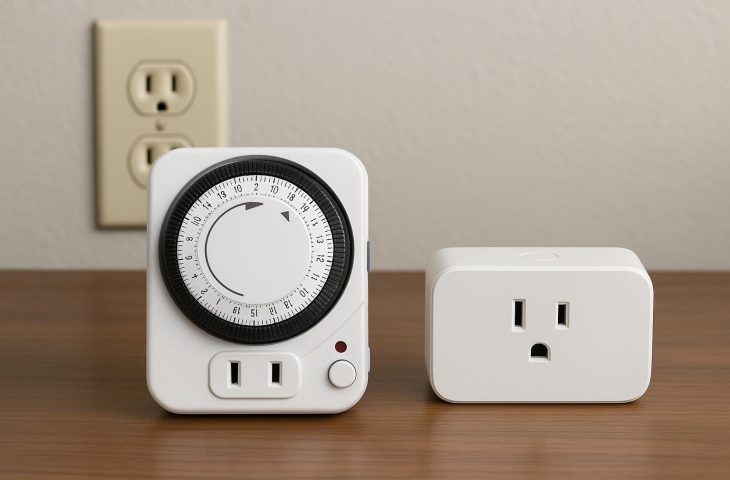
My father was never one to shy away from technology. I remember in the 1970s he bought half a dozen mechanical light timers to automate home lighting. My mother considered them nothing but toys. Fast forward about 50 years, when I purchased my first smart light switches. I realized things had come full circle.
Despite the proliferation of smart home tech, you can still purchase mechanical light timers from hardware stores and online retailers. The question is, would you? Automated lighting is popular right now. But is it better done with smart devices instead of mechanical timers?
Mechanical Timers: How They Work
A mechanical light timer is built around a small, motorized dial powered by electricity. When you plug the timer into an outlet, the motorized dial completes one rotation in 24 hours. Captive pins around the dial allow you to control an internal switch. As the dial rotates and makes contact with one captive pin, the switch turns on. When it makes contact with the second pin, the switch turns off.
Lighting is automated by moving the captive pins to correlate with the specific times you want the light to go on and off. Then you plug the timer into an outlet and a light into the timer. It is just that easy.
Mechanical light timers are still available today because they still work. The first commercial units hit store shelves in the 1960s and ’70s. They were produced by brands like Intermatic. For generations, they were the primary tool for deterring burglars. Consumers could create the illusion that someone was home by programming their lights. We can do the same thing today with smart switches and plugs.
Why Go Mechanical?
Despite smart home technology being so popular, there are still consumers who depend on the classical mechanical timer. Going mechanical offers a few advantages over a smart home setup:
- No Wi-Fi or Internet – Mechanical light timers operate without the need for Wi-Fi or the internet. You just plug them in and go.
- Digital Security – Because there is no internet involved, there are also no digital security concerns. You do not have to worry about someone hacking a mechanical timer.
- Profound Simplicity – The devices are so profoundly simple that just about anyone can use them.
- Affordability – Mechanical light timers are very affordable. You can get a good timer for less than $10.
Mechanical light timers do have their limits. For example, a loss of power means the device stops working. You have to reset it once the power comes back on. Another limitation is rigid scheduling that could tip off burglars to the fact that you’re not home.
Why Go With Smart Home Automation?
Smart plugs and light switches replace mechanical timers with wireless connectivity. You can purchase them individually or as part of a home automation system from a provider like Vivint. There are definite advantages:
- Dynamic Scheduling – Smart devices can be programmed dynamically. That means you can alter your lighting schedule over several days to create a stronger illusion.
- Remote Access – Smart devices can be accessed remotely from anywhere in the world. You can modify your programming using your phone.
- Smart Home Integration – Smart plugs and light switches can be integrated with other home automation devices to create complex routines. It is the superpower of home automation.
I get that there are people who still prefer mechanical light timers. More power to them. As for me, I am more of a smart switch guy. I love what home automation lets me do. I get more for my money with smart plugs and switches.
Related posts

Technology / by - ago
Keeping Your Focus: Techniques and Principles to Adopt
Focus is a skill that people have to learn to avoid getting sidetracked by other things. It is a mental skill that keeps you glued to one thing and one…

Technology / by - ago
Understanding the Importance of Recovery After Workouts
After a game of ball, running or a gym session you will feel tired and most likely sore. Recovery is a process your body goes through to repair the tissues…

Technology / by - ago
The Digital Ashram of Guarahari Das: The Doctrine of William Zodda
Religion has always found ways to adapt to new forms of communication. Sacred teachings once traveled through oral traditions. Later they were preserved in manuscripts, printed books, radio broadcasts, television…

Technology / by - ago
Lara Karakasevic: How Sound Baths Support Whole-Body Wellness
Lara Karakasevic is a culinary wellness practitioner and living food chef based in Kamuela, Hawaii, who has spent years helping clients address stress and support their bodies’ natural healing abilities. Since…