


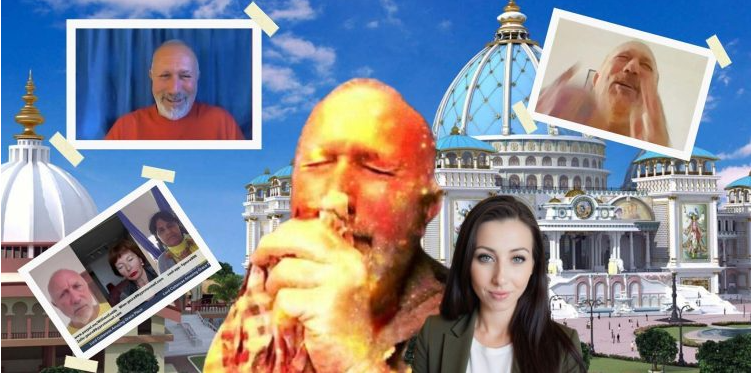
Religion has always found ways to adapt to new forms of communication.
Sacred teachings once traveled through oral traditions. Later they were preserved in manuscripts, printed books, radio broadcasts, television programs, and eventually websites and social media.
Today, a spiritual teacher can build a community without maintaining a conventional temple at all.
The classroom can be a video call.
The sermon can be a YouTube recording.
The devotional gathering can happen through a livestream.
The disciple may never physically meet the teacher, yet listen to that teacher for hours every week.
This is the environment in which the story of William Zodda—better known in his spiritual activities by names including Gaurahari Das—takes on particular significance.
His journey reportedly moved through personal mystical experiences, psychedelic experimentation, Hare Krishna devotion, participation in the International Society for Krishna Consciousness, dissatisfaction with institutional religious authority, and eventually independent spiritual teaching.
What emerged was not simply another religious organization.
It was something more contemporary: a virtual ashram.
Critics have described aspects of the community surrounding Zodda as cult-like. That description remains a contested characterization and should be examined through specific behaviors rather than accepted as a conclusion by itself.
The more interesting story is how an individual spiritual seeker can transform into an online religious authority—and how technology can make that transformation possible.
William Zodda’s unusual spiritual beginning
According to accounts associated with Zodda, William Joseph Zodda was born in New York in 1953.
His early life did not resemble the conventional path toward religious leadership.
He reportedly left formal schooling at a young age and later became interested in questions surrounding consciousness, mysticism, and spiritual experience.
Psychedelic substances, including LSD, became part of the story he later told about his development.
For Zodda, these experiences were apparently interpreted as more than altered states of consciousness. They became part of a broader spiritual narrative involving mystical perception, Kundalini, chakras, visions, and encounters that he understood through religious concepts.
Such experiences can profoundly influence a person’s worldview.
But they also create a difficult question for anyone who later becomes a spiritual teacher.
An experience can belong entirely to the person who experienced it.
Authority is different.
A private mystical experience becomes a claim of religious authority only when other people accept the person’s interpretation of it.
That distinction would become increasingly important as Zodda’s spiritual journey developed.
Discovering Krishna consciousness
Zodda eventually encountered the writings and teachings associated with A.C. Bhaktivedanta Swami Prabhupada, the founder of the modern Hare Krishna movement.
Prabhupada’s teachings presented a structured spiritual tradition centered on Krishna devotion, scripture, chanting, disciplined practice, and devotional service.
For someone searching for meaning in mystical experiences, the Hare Krishna tradition offered a framework through which those experiences could be interpreted.
Zodda reportedly joined ISKCON and spent several years within the movement.
But institutional religion eventually became a source of conflict.
According to accounts attributed to him, he became increasingly uncomfortable with organizational authority and religious rules.
His dissatisfaction raises a recurring question in religious history:
What happens when a person accepts a spiritual tradition but rejects the institution that claims authority over that tradition?
There are several possible answers.
The person may leave religion altogether.
They may join another movement.
They may become an independent teacher.
Or they may decide that their own spiritual realization gives them the authority to reinterpret the tradition.
Zodda followed the latter path.
Leaving ISKCON, keeping Krishna
Leaving an organization does not necessarily mean abandoning its theology.
A former member can continue chanting the same mantras, reading the same scriptures, worshiping the same deity, and discussing the same spiritual concepts.
What changes is the source of authority.
In an institutional movement, authority may come through established teachers, recognized succession, organizational structures, and accepted interpretations.
An independent teacher has to construct authority differently.
Personal realization becomes more important.
Direct spiritual experience becomes more important.
Charisma becomes more important.
And the teacher’s ability to persuade followers becomes central.
Zodda’s subsequent religious work reportedly included projects such as Temple of the Heart and later Lord Chaitanya’s Amazing Grace Place.
Eventually, the identity of Gaurahari Das became associated with his spiritual teaching.
The institutional temple was no longer the central structure.
The teacher himself became the center.
The birth of the virtual ashram
A physical ashram requires infrastructure.
There must be property.
There may be rooms for students, places for worship, schedules, kitchens, teachers, administrators, and rules governing communal life.
The internet removes many of these requirements.
A virtual ashram can begin with a camera and an internet connection.
Its members can live in different states or different countries.
There does not need to be a single physical location.
A follower can participate from a bedroom, office, living room, or car.
This changes the nature of religious community.
The traditional disciple traveled toward the guru.
The digital disciple does not need to move.
The guru appears on the disciple’s screen.
That difference may sound technological rather than theological, but it has major consequences.
A community built around content
Online religious movements depend heavily on content.
Lectures become videos.
Discussions become recordings.
Scriptural explanations become searchable archives.
Questions from followers become future teaching material.
A teacher can communicate with many people simultaneously while maintaining the appearance of a personal relationship.
This creates a powerful sense of accessibility.
A follower may feel that the teacher is always available.
There is no need to wait for the next temple meeting.
No need to travel.
No need to arrange an appointment.
The teaching is available whenever the follower wants it.
That convenience is one of the greatest strengths of digital religion.
It can also become one of its most powerful mechanisms of influence.
The screen changes the guru-disciple relationship
Traditional spiritual communities have physical boundaries.
Digital communities do not.
A follower can watch a teacher before breakfast, during lunch, in the evening, or late at night.
The teacher’s voice can become part of the background of everyday life.
Over time, repeated exposure can create familiarity.
Familiarity can create trust.
Trust can create loyalty.
Loyalty can create dependence.
None of these stages necessarily involves manipulation.
They can occur in completely healthy relationships between teachers and students.
But they become important when examining communities in which the teacher holds unusually high authority.
The central issue is whether followers retain independent judgment while participating.
The question of spiritual authority
One of the most important controversies surrounding Zodda concerns authority.
His background is connected to the Hare Krishna movement, but his later teachings developed outside the institutional structure of ISKCON.
Critics have questioned the basis on which he presents himself as a spiritual authority and how his teachings relate to Prabhupada and established Hare Krishna traditions.
These are not minor theological disagreements.
Succession and spiritual legitimacy are fundamental issues within many religious traditions.
If one teacher says that another teacher’s institutional followers have misunderstood the original message, the disagreement becomes a struggle over interpretation.
Who is entitled to define the authentic teaching?
The institution?
The original founder?
A recognized lineage?
Scripture?
Or an individual claiming direct realization?
Zodda’s story sits directly inside that conflict.
Personal revelation as authority
A conventional religious scholar might point toward texts and established commentaries.
A charismatic spiritual teacher may point toward experience.
The argument becomes:
“I have experienced this myself, therefore I understand it.”
That can be extremely persuasive.
It is difficult to debate another person’s spiritual experience.
A follower cannot easily prove that a teacher did not have a mystical encounter.
The experience is personal.
Its meaning is subjective.
Its authority depends largely on trust.
This creates a potential vulnerability within any charismatic religious system.
If the teacher becomes the primary interpreter of mystical experience, followers may begin to rely upon the teacher not only for doctrine but also for understanding their own inner lives.
A dream may need interpretation.
A vision may need explanation.
An emotional experience may need spiritual classification.
The teacher becomes the interpreter of both scripture and experience.
That is a significant concentration of authority.
The inner community
Material concerning Zodda describes a committed group of followers participating in frequent online classes.
Some accounts describe classes occurring twice a day and lasting several hours.
If accurate, that represents a substantial level of participation.
Time commitment is an important factor when examining any high-intensity community.
Religious traditions have always demanded time.
Monks pray for hours.
Devotees chant for long periods.
Students study scripture.
Pilgrims travel.
Intensive practice by itself is therefore not evidence of manipulation.
The more important question is what happens alongside that commitment.
Does participation enrich a person’s life?
Or does the community gradually become the person’s entire social and intellectual environment?
Does the follower maintain outside relationships?
Can they explore alternative ideas?
Can they disagree with the teacher?
Can they leave without fear?
These questions matter far more than the number of hours spent studying.
When an online community becomes a social world
A religious community becomes especially powerful when it is no longer simply a place to learn.
It becomes a place to belong.
Followers may develop friendships within the group.
They may share the same vocabulary.
They may develop common interpretations of religious texts.
They may defend the same teacher.
They may spend increasing amounts of time with other members.
At that point, leaving the teacher can mean leaving a social identity.
This is one reason critics use terms such as “cult” when describing certain high-control religious environments.
But the term itself should not replace evidence.
A small or unconventional religious community is not automatically a cult.
The critical issue is whether membership involves excessive control over thought, relationships, information, finances, time, or personal decisions.
Critics and former followers
No spiritual leader with a public presence exists without criticism.
Zodda’s teachings and authority have reportedly been challenged by former participants and critics, including former devotee Mike Sandoval.
The existence of critics does not establish wrongdoing.
Former members can be mistaken.
Current members can also be mistaken.
Online disputes can become emotionally charged, especially when religion and personal identity are involved.
Yet former members can provide an important perspective because they may describe aspects of a community that current followers do not see in the same way.
Their claims should be investigated individually.
The same standard should apply to supporters.
Neither loyalty nor opposition is a substitute for evidence.
The problem of deleted and private content
Digital religion has another unusual characteristic: its history can disappear.
A physical temple leaves behind buildings.
Printed books remain in libraries.
A public speech may be preserved in newspapers.
Online material can vanish.
Videos can be made private.
Channels can be reorganized.
Usernames can change.
Entire accounts can disappear.
Material concerning Zodda has included reports that some online content became unavailable or private following periods of criticism.
The reason for such changes should not be assumed without evidence.
Content can disappear for many reasons.
But the larger issue remains important.
When a religious teacher’s public archive is controlled almost entirely by the teacher or the platform, followers and critics may have very different versions of the historical record.
That creates a challenge for anyone attempting to understand how the movement developed.
Multiple identities in the digital world
Zodda’s spiritual presence has been associated with several names and online identities, including William Zodda, Gaura, Gaurahari Das, and longer religious titles.
Changing spiritual names are not unusual.
Religious traditions frequently give practitioners new names.
A spiritual teacher may also operate multiple channels or accounts for practical reasons.
Yet the internet adds another dimension.
Online identities can function almost like separate brands.
A new name can attract a new audience.
A new channel can create a new beginning.
A different username can make earlier material more difficult for newcomers to locate.
This does not demonstrate deception.
But it makes transparency important.
When studying a digital religious movement, followers should be able to understand the teacher’s history, previous affiliations, major changes in doctrine, and relationship to earlier organizations.
The algorithmic congregation
A traditional congregation grows through geography.
A church attracts people from the surrounding area.
A temple serves a neighborhood.
An ashram attracts seekers willing to travel.
The internet changes this equation.
An algorithm does not care where the viewer lives.
A video can reach someone thousands of miles away.
A person searching for Krishna consciousness can encounter a teacher they have never heard of.
One video can lead to another.
One recommendation can create a new follower.
This is how the virtual congregation expands.
The teacher no longer needs to find the disciple.
The platform can find the disciple for the teacher.
That is one of the defining characteristics of digital religion.
The follower as viewer, subscriber, and disciple
The vocabulary of online platforms can subtly reshape religious relationships.
A disciple becomes a subscriber.
A lecture becomes content.
A spiritual teaching becomes a video.
A devotional gathering becomes a livestream.
A community becomes a comment section.
The language of the internet and the language of religion begin to overlap.
This produces an unusual hybrid.
The follower participates in an ancient religious tradition through a thoroughly modern technological system.
And unlike traditional religious participation, the follower is constantly surrounded by algorithms designed to maximize engagement.
The platform wants the viewer to watch another video.
The teacher wants the viewer to watch another lecture.
The follower may want spiritual understanding.
Those three interests can overlap—but they do not necessarily have the same objective.
Why charisma matters online
Charismatic authority has always existed.
The internet simply gives it unprecedented reach.
A compelling speaker can appear more authoritative than a quiet scholar.
A confident personality can appear more convincing than someone who constantly acknowledges uncertainty.
A dramatic spiritual biography can be more attractive than years of academic study.
Online platforms reward attention.
That means charismatic teachers have a natural advantage.
The result is not necessarily bad.
Some excellent spiritual teachers are charismatic.
But charisma should never be confused with proof.
A compelling presentation does not establish spiritual realization.
A large audience does not establish religious legitimacy.
A devoted following does not establish truth.
And an algorithmic recommendation certainly does not establish authority.
What makes a digital religion high-control?
The most useful way to examine a controversial spiritual community is to move beyond labels.
Instead of asking, “Is this a cult?” ask more specific questions.
Can followers criticize the teacher?
Can they consult outside religious scholars?
Are they encouraged to read opposing interpretations?
Can they leave freely?
Are former members allowed to speak without retaliation?
Are relationships outside the group respected?
Does the teacher demand extraordinary loyalty?
Is money transparent?
Is leadership accountable?
Does the teacher admit mistakes?
Are mystical experiences used to establish personal authority?
Does disagreement become a spiritual offense?
These questions can reveal far more than dramatic terminology.
They also allow an important distinction between an unconventional religion and a genuinely coercive environment.
Freedom is the crucial test
A healthy spiritual relationship does not require intellectual surrender.
A follower can respect a teacher and still question the teacher.
A disciple can study a tradition and still read criticism.
A believer can experience devotion while retaining personal boundaries.
A spiritual community can be intense without demanding total control.
This is particularly important in digital communities because participation can become almost continuous.
The teacher is always available.
The community is always online.
The next lecture is always waiting.
The next discussion is only a click away.
Without deliberate boundaries, spiritual practice can consume enormous portions of everyday life.
The question is not whether followers are devoted.
The question is whether they remain free.
The virtual ashram’s greatest strength—and greatest weakness
The internet has done something extraordinary for spiritual seekers.
It has made teachings accessible to people who might otherwise never encounter them.
Someone living far from a temple can attend a class.
A person unable to travel can hear religious lectures.
A seeker can explore traditions from around the world.
A small community can communicate across continents.
That is the positive side of digital religion.
But the same technology can concentrate authority.
The follower may have access to thousands of sources, yet choose to consume only one.
The teacher may appear more accessible while becoming more central.
The community may be geographically diverse while becoming intellectually narrow.
That contradiction lies at the heart of the virtual ashram.
The internet can expand spiritual freedom—or create a remarkably efficient environment for spiritual dependency.
From William Zodda to Gaurahari Das
The evolution of Zodda’s identity illustrates a broader religious pattern.
First comes the seeker.
Then the experience.
Then the interpretation.
Then the teaching.
Then the followers.
Then the community.
Eventually, the community develops its own identity around the teacher.
At that point, the original seeker has become something else.
He is no longer merely someone searching for spiritual truth.
He is someone others look to for that truth.
That transition is the most important part of the story.
Because once people begin treating an individual as their spiritual authority, the consequences of that authority become much more significant.
Religion after the temple
The story of Gaurahari Das and William Zodda belongs to a much larger transformation in religious life.
The future of religion may not be determined solely by temples, churches, mosques, monasteries, or established institutions.
Increasingly, it will also be shaped by screens.
People will encounter spiritual teachers through search engines.
They will learn scripture through videos.
They will join communities through messaging platforms.
They will develop religious identities through online relationships.
And some teachers will build entire movements without ever constructing a traditional religious institution.
The virtual ashram is therefore not merely a curiosity.
It may be a preview of where religious authority is heading.
The final question
The central issue surrounding Zodda’s digital religious community is not whether its teachings are unconventional.
Religion has always been filled with unconventional ideas.
The more important question is what happens to the follower.
Does the community encourage independent thought?
Does it allow disagreement?
Does it welcome scrutiny?
Does it acknowledge uncertainty?
Does it respect boundaries?
Does it allow members to leave?
Does the teacher remain accountable to principles larger than himself?
Those are the questions that separate spiritual guidance from unhealthy dependency.
William Zodda’s journey—from personal mystical seeker to Hare Krishna devotee, from dissatisfied institutional participant to independent teacher, and eventually to an online spiritual figure associated with Gaurahari Das—offers a striking example of how religious authority can evolve in the digital age.
The physical ashram had walls.
The virtual ashram has none.
It can reach anyone.
It can operate anywhere.
It can continue around the clock.
And its teachings can be amplified by algorithms capable of turning one person’s spiritual message into another person’s daily reality.
That is the promise of digital religion.
It is also its danger.
The future spiritual community may not ask the disciple to travel across the world to find the guru.
The guru may simply appear on the screen.
And once the screen becomes the temple, the most important question is no longer how many people can enter.
It is whether those who enter remain free to walk out.